What AI Product Photography Is Actually Good At
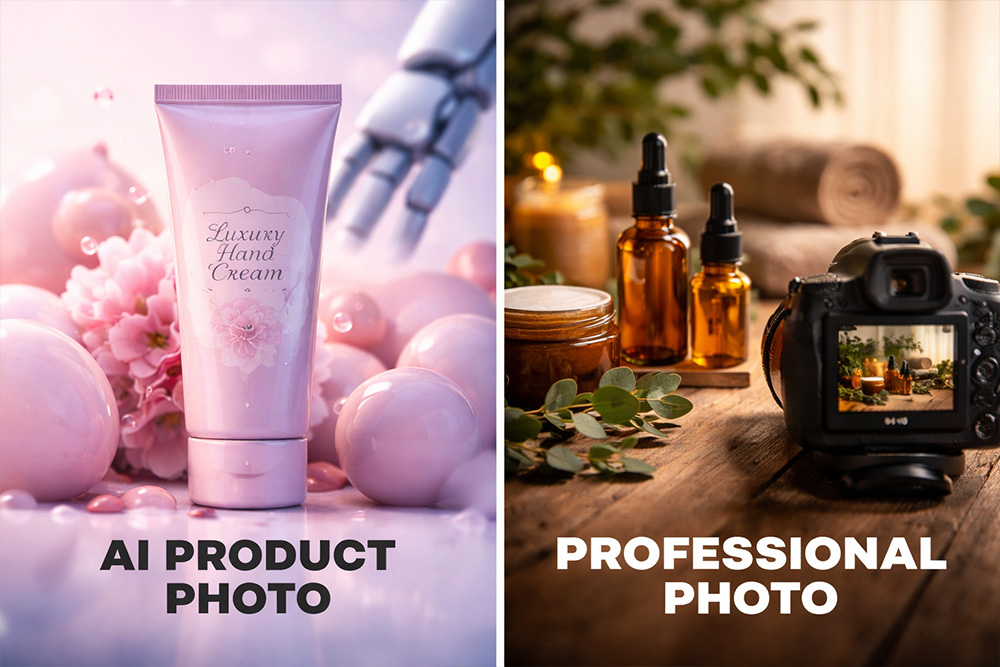
In the professional product photographer vs AI discussion, it’s important to recognize what AI is genuinely good at before we talk about its limitations. Before we talk about photographers, let’s be fair with AI. In 2026, AI image generators and editing tools can:
Create concept visuals and mockups for pitches, landing page drafts or social posts.
Test different backgrounds, colors, and lighting styles quickly.
Extend scenes or remove small imperfections in a fraction of the time traditional retouching takes.
Help small businesses produce “good enough” visuals when there is no budget for proper photos at all.
For early-stage ideas and internal work, this is amazing. AI is like an assistant that never gets tired of trying yet another angle.
The problem starts when “good enough” visuals meet real customers.
1. Authenticity and Trust Are Hard to Fake
People are getting very good at spotting AI-generated images. Sometimes it’s obvious (weird reflections, strange shadows, tiny distortions), sometimes it’s just a feeling that something looks “too perfect”.
For product photos, that matters a lot:
Customers want to see what they are actually buying, not a fantasy version of it.
Over-polished, obviously artificial images can reduce trust, especially in beauty, food, fashion, health, and tech.
User-generated content (UGC) and influencer shots still perform so well because they look and feel real.
A professional photographer can:
Capture your real product, as it is, in a flattering but honest way.
Show natural imperfections that actually build trust (“this is a real object, not a render”).
Work with models, hands, and real environments that make your product part of a believable story.
AI can hallucinate a product. A photographer can document it.
2. Brand Consistency Needs More Than a Prompt
Most brands underestimate how fragile their visual identity is. Change the lighting, angle or color treatment too much, and suddenly your social feed looks like it belongs to three different companies.
AI tools can be prompt-based and unpredictable:
The same prompt may generate slightly different looks every time.
Tiny changes in wording can completely change style, mood, and color palette.
Matching a very specific brand photography style across many images is still difficult and time-consuming.
A professional product photographer will:
Build a repeatable lighting setup for your brand.
Use the same color calibration, lenses, and retouching approach across sessions.
Plan your shoots as systems, not isolated images – so campaigns, product families, and seasons all feel like they belong together.
You’re not just paying for pictures. You’re paying for a visual language that stays consistent across your website, marketplace listings, ads, and packaging.
3. Handling Complex Products, Surfaces, and Regulations
AI loves smooth, matte, symmetrical objects. Reality… not so much.
Some product categories are especially hard to fake convincingly:
Reflective surfaces: glass bottles, chrome, jewelry, electronics.
Transparent or semi-transparent packaging: perfumes, oils, skincare.
Food and beverages: steam, texture, melting, liquids in motion.
Highly regulated products: medical devices, supplements, tools, baby products.
In many industries, showing a product inaccurately is not just bad UX – it can be legally risky. A professional photographer understands:
How to control reflections and transparency with studio lighting.
How to show portion sizes, textures, or color variations clearly.
How to respect labelling, safety information, and regulations in every shot.
AI, on the other hand, might confidently “invent” details that don’t exist on your product at all.
4. Real Collaboration vs. Talking to a Prompt Box
Working with a professional product photographer is a conversation, not just a command line.
You can:
Discuss strategy: “What do we want customers to feel when they see this product?”
Adjust during the shoot: “Let’s try a closer crop,” “Let’s add a hand in the scene.”
Get professional advice on props, backgrounds, model choices, and styling.
Build a long-term relationship where the photographer understands your brand almost as well as you do.
With AI tools:
Your only interface is the prompt.
If you don’t know how to speak “prompt language”, results can be frustrating and inconsistent.
You spend more time tweaking, re-generating, and editing than you expected.
A photographer brings taste, experience, and judgement into the process – things that are hard to encode into a few lines of text.
5. Ownership, Licensing, and Legal Grey Areas
Another reason to keep a professional photographer in the loop: legal clarity.
With AI images, depending on the tools and training data, you may run into questions like:
Who really owns the copyright to the generated image?
Was the model trained on someone else’s work in a way that could create legal issues?
Can this image be used safely in paid advertising worldwide?
With a professional photographer and a clear contract, you know:
What rights you are buying (usage, duration, territories).
That the photos were created from scratch, specifically for your brand.
That retouching, models, and locations are all properly handled and released.
That peace of mind is worth a lot when your visuals are seen by thousands of people.
6. AI + Photographers: The Smart Hybrid Approach
This is not a war between AI and humans. The smartest brands in 2026 are doing both:
In practice, that means your next product shoot might start with an AI-generated moodboard, but it still ends in a real studio with real lights and a real camera.
7. When Is AI Alone “Good Enough”?
In the ongoing professional product photographer vs AI debate, there are a few situations where AI-only visuals might be enough – but they’re rarer than most people think. There are cases where AI-only visuals might be enough:
Early-stage prototypes where the real product doesn’t exist yet.
Internal presentations, idea testing, investor decks.
Very small side projects with zero budget and low risk.
Background variations and minor creative experiments around existing lifestyle photos.
Even there, be honest with yourself and your audience: if what you show is not the real product, say so or clearly label it as a concept.
When You Really Should Call a Professional Product Photographer
If any of these are true, AI-only is a risky shortcut:
You’re launching a new flagship product or rebranding.
You sell on Amazon, marketplaces, or your own ecommerce, where photos directly drive conversion.
Your niche requires high trust: skincare, supplements, tech, jewelry, home goods, kids’ products.
You need consistent imagery for website, packaging, social, and ads.
You want to build a brand that can grow for years, not just “try to sell something quickly”.
In those cases, think of a pro photographer as part of your brand infrastructure, not a “nice to have”.
How Qubed Agency Fits into This Picture
At Qubed Agency, we see product photography as a core part of brand experience, not just decoration. Our goal is to help you treat the professional product photographer vs AI question as a strategic choice, not just a way to cut short-term costs.
We help clients:
Define the visual direction of their product photography (style, mood, angles, backgrounds).
Create photo guidelines that photographers can follow across multiple shoots and campaigns.
Collaborate with professional product photographers (from our network or yours) to keep everything on-brand.
Use AI tools carefully:
for early concepts,
as support for retouching,
or to extend scenes around real photos – never to fake what the product really is.
If you’re unsure how to balance AI convenience with real-world quality, we can help you design a product visual strategy that uses both, without compromising your brand.